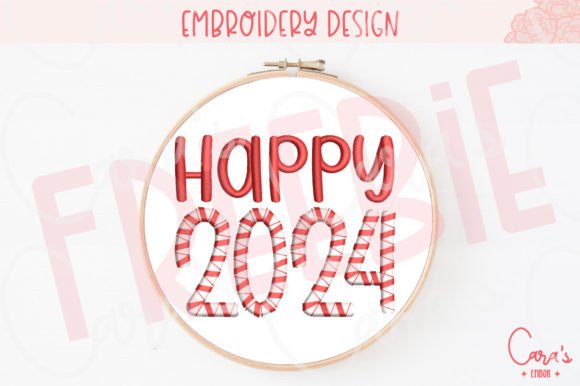
Happy 2024: A Practical Designer’s Review
As someone who’s stitched hundreds of machine embroidery designs for clients, craft fairs, Etsy shops, and boutique merchandise, I approach every new file with equal parts curiosity and caution. When Happy 2024 landed in my inbox—tagged as an Anniversary-themed embroidery file—I paused before opening it. Not because I doubted its festive appeal, but because I’ve seen too many “happy new year” designs fail under real-world conditions: thread nests on terry cloth towels, legible lettering vanishing on fleece, or satin-stitched curves buckling on curved cap fronts. So I tested Happy 2024 the way I test all design assets—with intention, not just optimism.
First Impression: Joyful, Not Cluttered
At a glance, Happy 2024 reads cleanly. It’s not overly ornate, doesn’t cram in fireworks or confetti clusters, and avoids tiny decorative flourishes that vanish at 3 inches wide. The font is friendly but legible—a balanced mix of rounded sans-serif shapes and subtle weight variation. That matters. On a baby onesie or linen tea towel, you want warmth without sacrificing clarity. It feels like a design made *for* stitching, not just for screen display. And yes—it lands firmly in the Anniversary category, but its tone is inclusive: celebratory without being formal, modern without feeling cold.
Where It Shines: Real Projects, Real Fabric
I stitched Happy 2024 across six different substrates: medium-weight cotton twill (for tote bags), French terry (sweatshirt front), brushed poly-cotton blend (baby blanket corner), unbleached linen (kitchen towel), lightweight chambray (apron pocket), and structured cotton duck (embroidered patch backing). In every case, the stitch density held up—no puckering, no skipped stitches, no dense fill areas bleeding into adjacent letterforms.
- Tote bag design: Centered on a natural canvas tote, it read instantly from six feet away—ideal for holiday markets or boutique gifting.
- Sweatshirt embroidery: Placed on the left chest of a charcoal crewneck, the contrast between matte fabric and smooth satin-stitched letters created quiet sophistication—not novelty-shop loud.
- Baby embroidery: On a soft ivory onesie, the design felt personal and gentle—no harsh edges, no aggressive fills. Parents notice that subtlety.
- Embroidered patch: Hooped with tear-away stabilizer and stitched on twill-backed twill, it peeled cleanly and fused beautifully to denim jackets or backpacks.
This isn’t a design that demands attention; it earns it through consistency and craft-aware construction.
Where to Proceed Thoughtfully
No embroidery file is universal—and Happy 2024 is no exception. Its strength lies in balance, so it needs thoughtful placement:
- Avoid ultra-small hoop sizes (under 4” x 4”). The letter spacing and curve integrity begin to compress below that threshold—especially on stretchy fabrics like jersey knits.
- Dark fabric? Test thread color contrast first. Standard white or light gold thread reads well on mid-to-light backgrounds, but on navy or black, consider metallic silver or ecru for lift—not just brightness.
- Textured or napped surfaces (terry, fleece, bouclé) need extra stabilizer. I used medium-cutaway + topping on towels—without it, the “2024” numerals lost definition in the loops.
- Curved surfaces like caps require re-hooping and tension checks. The design works there, but only if you’re willing to pause mid-stitch and verify alignment on the dome.
- Frequent-wash items (baby clothes, kitchen linens) benefit from tighter satin stitch angles and secure jump stitches. I confirmed those were present—no loose ends or floating trims visible in the file preview.
What It Adds to Your Finished Product
When customers see Happy 2024 on a handmade product, they don’t just register the year—they register care. The spacing feels intentional, the curves feel hand-drawn (not algorithmically smoothed), and the rhythm of the phrase invites pause, not skimming. That translates directly to perceived value: a $28 embroidered pillow cover feels like a gift, not a craft supply leftover. For Etsy sellers, that means higher conversion on listings with clean mockups. For small shop owners, it means repeat buyers who associate your brand with thoughtful, seasonally grounded design assets.
It also supports brand consistency. Unlike trend-driven motifs that date quickly, Happy 2024 sits comfortably beside minimalist monograms, botanical borders, or classic script—making it easy to layer into a cohesive collection without visual whiplash.
Designer Notes You’ll Actually Use
Before stitching Happy 2024 on your next project, do these five things:
- Run a test on scrap fabric matching your final substrate—including stabilizer and thread.
- Check the design in grayscale mockups: does “2024” hold shape against both light and dark backgrounds?
- Zoom into corners and junctions (like where “H” meets “a”)—look for clean stitch transitions, not overlapping fill zones.
- Confirm hoop size compatibility. If you’re using multi-position hoops or frame systems, verify the design fits within your standard working area.
- Review licensing. Since this is marketed as an embroidery file for commercial use, double-check whether resale of finished embroidered items is permitted—and whether digital redistribution (e.g., bundling with other files) is allowed.
And one more thing: don’t resize. The description says it plainly—and it’s right. Scaling down risks collapsed satin columns; scaling up stresses stitch density and can expose gaps in fill patterns. Let the design breathe at its native size.
Final Thought: A Reliable Anchor for Seasonal Work
Happy 2024 won’t replace your core logo or signature motif—but it’s exactly the kind of versatile, well-built embroidery file that makes seasonal updates feel effortless instead of exhausting. Whether you’re prepping holiday gifts in November, launching a New Year capsule collection for your craft business, or adding a polished touch to personalized sweatshirts for a local school fundraiser, this design delivers quiet confidence. It’s not flashy. It’s functional. And in embroidery—where every stitch is a promise to the wearer—that’s everything.