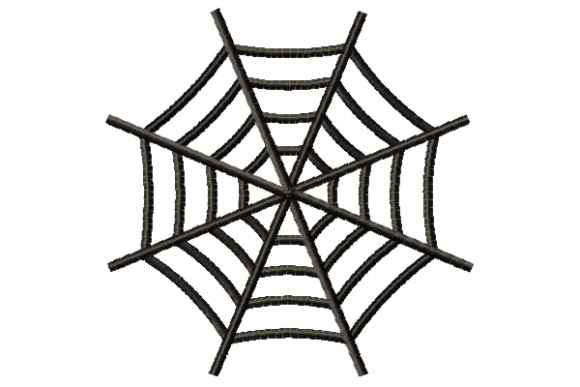
Spiderweb: A Smart Embroidery Choice for Small Business Branding
First Impression: Playful Yet Polished
Right off the bat, Spiderweb reads as delightfully balanced—whimsical enough for a children’s boutique or indie pet brand, yet clean and structured enough to hold its own on a café apron or florist’s tote bag. It doesn’t scream “costume” or “Halloween-only.” Instead, it leans into organic symmetry and subtle intricacy—like a hand-drawn sketch translated with precision into stitch. That duality makes Spiderweb unusually versatile for small business merch: it feels handmade without sacrificing professionalism, friendly without looking childish, and decorative without overwhelming your core branding.
Real-World Use Across Business Touchpoints
As an embroidery designer who’s stitched logos for bakeries, studios, and local makers, I’ve tested Spiderweb across multiple applications—and it shines where many free designs falter. On embroidered patches? Excellent. Its radial structure holds shape beautifully at 2.5"–3.5", especially when backed with medium-weight cutaway stabilizer. For cap embroidery, place it subtly on the side or back panel—it avoids the distortion risks of front-panel placement while adding quiet brand personality. On aprons and staff uniforms, Spiderweb works best as a chest accent or sleeve detail: small enough to avoid visual clutter, distinctive enough to spark conversation.
For tote bag design and custom apparel, Spiderweb scales well up to 4.5" without losing clarity—ideal for boutique merchandise where customers expect thoughtful details. As a product packaging accent (think sewn-on tags for handmade soaps or candles), it adds tactile authenticity. And yes—it’s a natural fit for customer gifts: pair it with neutral thread colors on cotton muslin bags or tea towels, and you’ve got a memorable, low-cost branded keepsake.
Where to Use Spiderweb Thoughtfully
Even strong designs have limits—and knowing them prevents costly rework. Spiderweb has moderate stitch density and defined outlines, which means it performs best on stable, medium-weight fabrics like twill, canvas, or midweight cotton. Avoid placing it directly on highly textured fabric (like bouclé or heavy terry) without extra stabilizer testing—it may lose definition in the pile. On dark uniforms, confirm thread color contrast: light gray or ecru thread can read softly; opt for charcoal or navy for legibility.
Small patch sizes (under 2") demand caution. While Spiderweb is inherently scalable, fine web strands may collapse or merge below 1.75". Always test at your target size first—especially if using it for woven labels or mini iron-ons. Also, skip curved surfaces like baseball cap fronts unless you’re using a high-tension hoop and dense stabilizer combo. And though the description mentions it’s a machine embroidery design suitable for clothes and gifts, double-check whether it includes underlay or pull compensation—critical for clean results on stretchy or knit fabrics used in modern work shirts.
Brand Identity & Customer Perception
Here’s what matters most to small business owners: Spiderweb strengthens brand identity not by shouting, but by whispering consistency. When repeated across aprons, tote bags, and staff caps, it builds visual rhythm—subtle, recognizable, and cohesive. Customers associate that repetition with care and intentionality, not randomness. That perception lifts perceived product value: a $28 tote bag with Spiderweb stitched cleanly reads more premium than one with a generic vector logo printed flat.
For Etsy sellers and handmade brands, Spiderweb supports the “human-made” story. It looks crafted—not templated—so it pairs naturally with rustic packaging, handwritten tags, and printable mockups shared on social media. It also invites engagement: people notice the geometry, ask about meaning, and remember the brand behind the detail. In short, Spiderweb isn’t just decoration—it’s a quiet trust signal.
Practical Designer Notes Before You Stitch
Before committing Spiderweb to your next commercial embroidery run, here’s my checklist:
- Test in black and white first. Confirm all elements register clearly—no lost filaments or ambiguous spacing.
- Check minimum viable size. Resize down to your smallest intended use (e.g., 2" patch) and verify web strands remain distinct.
- Review thread color options. Try matte cottons vs. high-sheen poly—some sheens exaggerate stitch density and flatten dimension.
- Inspect spacing between web lines. Tight gaps may close up on dense fabric; adjust tension or stabilizer if needed.
- Confirm hoop size compatibility. Does Spiderweb fit your standard hoops without re-hooping mid-stitch? If not, plan for nesting or alternate hooping.
- Test on real fabric—not just backing. Run a sample on your actual garment or patch material, with correct stabilizer layers.
- Create a client-approved mockup. Show how Spiderweb sits beside your existing design assets—logo, typography, color palette—to ensure harmony.
- Verify commercial licensing. Since this is listed under Freebies, confirm whether the embroidery file permits resale, branded merchandise, or third-party production. Never assume.
Final Thoughts for Merch Creators & Embroidery Shops
Spiderweb stands out in the Embroidery category because it bridges function and feeling. It’s not just a digital embroidery file—it’s a flexible brand asset. Whether you’re stitching for a neighborhood florist launching branded totes or a craft studio building signature aprons, Spiderweb delivers cohesion without constraint. It respects the craft (clean stitch paths, logical jump points), serves the business (scalable, license-aware, production-ready), and connects with people (charming, memorable, quietly confident).
Just remember: even the best machine embroidery design is only as strong as your prep. Test early, stabilize intentionally, and always align Spiderweb with your broader brand language. When done right, it won’t just decorate your merch—it’ll deepen your story.